
Memories. We all have them. They make us who we are. They make us human. Where would we be without them?
Some memories are more precious than others. Think of that time you got that favourite present from your parents. Now think of that time you got in trouble for something you didn’t do. I bet all of us can point to a few lasting memories from our childhood.
If you were asked to attach an objective value to any memory from your past, would you be able to do it? The answer is no, most likely. We do not have a way to value memories in the same way we can quantifiably value things such as money. And unlike money, memories cannot really be exchanged between different people.
However, what we can do is compare the relative value of different memories we hold. This is something that is highly subjective. One person’s value system for the exact same memory may be different from another person who experienced the same event.
So at a personal level, how do you value the memories that you hold? What is more precious to you? And on the other hand, which memories have become the most painful to hold?
In this article, I’d like to propose a completely unique lens through which you could view your bank of memories. To do so, we must borrow some basic concepts from the field of finance.
In financial theory, the Time Value of Money concept rules above all others as the one overarching metaphorical king. All other financial concepts seem to flow from this one. The simplest way of stating this is that “a dollar today is better than a dollar tomorrow.” If you invest an amount of money today in a bank account, you’ll earn some interest in a year’s time. This is better than receiving the same initial sum of money one year later, as the opportunity to earn interest has now been lost.
This concept can be applied to our memories to form a valuing system for memories from different time periods throughout our lives. Is it safe to say that your most joyful or traumatic childhood memories can have long-lasting effects well into your adult life? The memories that you remember vividly from years ago are still earning interest on your life. And just as interest rates can work for you, they can often work against you in the form of debt. The bad memories from long ago can still influence our major life decisions, year by year.
Realising the power of the Time Value of Memories can be the key to unlocking a brighter future for yourself. Every day, we have the power to create new memories for ourselves. We also have the ability to document and maintain little cues to nudge our memory, just when our future selves need help as they come across a potential stumbling point. Although we can’t change the past, we can use this concept around memories to make life decisions that set our future selves up for a better life.
Investing using money can be an amazing tool to improve your life in the long term. But investing in positive, long-lasting memories can set you up even better for the future. If at any point you are ever faced with a fork-in-the-road life decision, it can be helpful to consider the resulting memories that would arise from those decisions. Will it create numerous different memories and experiences you can draw upon in future? Or will it lead to a similar and repeated pattern of experiences that converges into a singular memory? Thus, money and other equally important extrinsic factors can be weighed against the memory implications of major life decisions.

The key to living authentically comes through an understanding of self versus an understanding of ‘the other’. Our memories make us who we are, and every human is unique partly due to their unique set of memories, even when other characteristics such as DNA are held equal in the context of twins. But of course, often we all forget who we really are. It’s such a common problem in today’s day and age. The problem is that we are often too focused on ‘the other’. Thank social media for that. Over-institutionalised thinking is also a main contributor. Only through a thorough journey down memory lane can we transcend into our true selves, your inner child if you’d like.
One way of utilising the Time Value of Memories is not through the memory itself, but from how a memory is captured. A prominent example would be journaling. This is in essence increasing the time value of a particular day or memory, so that the value can be unlocked when you read the journal entry in future. The value is increased further when for example, a descendant of someone who has passed away reads the journal. The same can be said for photographs, videos, and audio recordings of many candidly authentic moments. These forms of media all convey the emotions, thoughts, and feelings of those who create the memory and those who are captured by it. Without these memories being captured in some way, many of us will often forget the little moments that form the big chapters of our lives. The value of telling others about our memories, or keeping in touch with people who hold memories of us at a crucial point in time also cannot be understated.

So now we’ve gone over two important aspects in the Time Value of Memories formula: creating the memories and capturing them. There is one more major aspect of the equation, which sits in the name itself. Time. The one thing that no one can beat. But it’s also the one thing that gives our memories seriously amazing power. Once you have created some special memories and captured them well, time will do the rest of the work. Every day and year that follows, your positive memories become more valuable, growing in interest just like your savings account does. When you look back on beautiful memories 50 years on, a special feeling is evoked and you remember who you were in the days of your youth. This is also the reason why travel or an overseas experience can be so valuable for a 20-year-old compared to a 60-year-old. The huge swathe of exciting new experiences and memories has 40 extra years to define and empower the young person.
The Time Value of Memories Equation
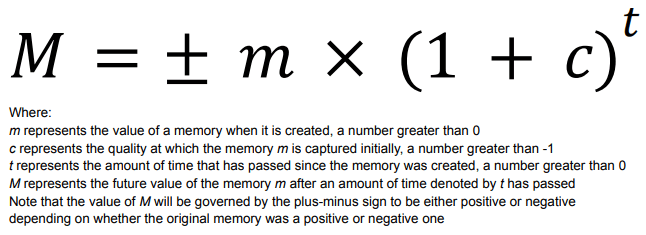
With the three main components of the Time Value of Memories in hand, you are now ready to begin building up your bank of highly-prized and valuable memories. But I bet you’ve already started! The goal is to begin living more intentionally with these concepts in mind now. “How do I do that?” you may ask. Go ask out that girl (or boy), and make some memories even if you fail. Take that silly selfie when you’re at that tourist attraction – go on! And make sure to do that thing you’ve always wanted to do today as opposed to tomorrow, especially if the opportunity is there for the taking.
As the famous saying did NOT say:
“The journey of a thousand miles begins with a single memory.”
One of the best ways to maximise the Time Value of Memories for yourself is to take hold of any once-in-lifetime-opportunities that come your way in life. Listen to the CwD podcast about once-in-lifetime-opportunities for more inspiration to live your best life!

 Chillin’ with Dylan