The following speech was written in 2018 for a university business student competition — we’ll let the robots judge whether it aged well 😉
Today I’ve been given the topic of making the world a better place, my vision of how business will change the future. However, before I start, I want to set the mood. I feel like the entire idea of focusing on how businesses can change things is already a step in the wrong direction. I think we can go bigger than that. We need to focus on how people can change things instead. Why? Because when we talk about what business can do, we immediately separate our own personal responsibility for making a positive impact. That somehow, if we make a questionable decision in the name of business we can just come home and donate to a charity that solves a problem that was probably caused by a decision made by someone else in the name of business.
To make real meaningful change, we need to focus on the people, and those of us in business need to be leading the charge. A business is made up of people. These people work together and are connected to the world through networks amplified by technology. This gives businesses power to make an impact greater than its immediate reach, and the most powerful tool we can use is culture. Over the years, I’ve seen for myself how a great organisational culture can attract people and change long-held perceptions. If business leaders can build their culture and empower people to become truly passionate about creating positive impact, then we would make a massive stride towards changing the world.
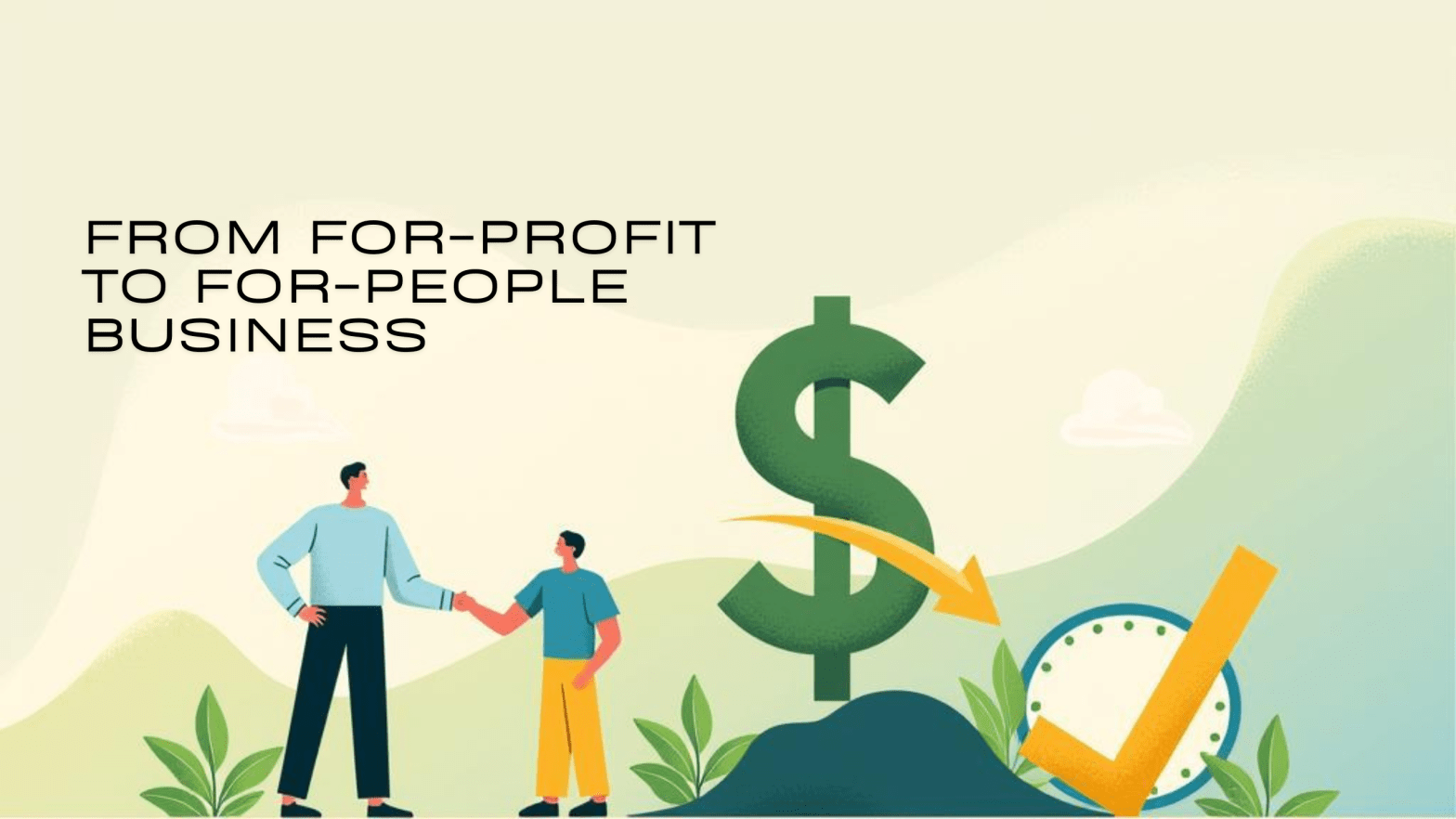
The first step to solving many problems is to simply change the language we use. If I asked you what a banana was, would you ever respond with “oh that’s just a not-apple”. No, you’d say it’s a banana. So why don’t we call not-for-profits for-people organisations instead? Sometimes we just gotta take a step back. Evaluate the true purpose of business in the first place. Profits. But what’s that for? It’s for people. If we can unite businesses, charities and even social enterprises to become human-focused enterprises instead, then the whole game changes. Then there’s a big shift in perception. Imagine what that could do and how it would drive people to act differently?
If I were to ever start my own business, I’d want to take payment in smiles instead of money. Because currencies differ between countries, but a smile is universal, right? Practically it would be kind of hard to do though. So it seems as though I’ll never start something. Unless some genius invents some super-advanced AI technology which uses facial recognition to capture peoples’ emotions and convert it into digital currency on the blockchain. Phew! Where am I going with this?
Technology is changing the world. Many jobs we see today will not exist in 5, 10, 20 years’ time. The fourth industrial revolution could wipe out entire industries. Processes are already being automated in government, business and even our university clubs. When the same tasks traditionally performed by humans can no longer sustainability generate profits, we need to turn our energy into activities which generate value for people. Automation can only take us so far, it’s up to us how we enhance our lives with the technology that gives us the power and freedom to do so much. Robots are already better than humans in so many aspects, but they will never be better at caring and empathising with other humans. Real change will be driven by people. People with the passion, creativity and grit needed to use technology as a tool to improve human lives.
This is precisely why people in government, education and especially business need to take on a greater role in empowering everyone to have access to technology. Not only that, we need to help people understand what different types of technology are and how they fundamentally work. Because technology will be what shapes the most part of peoples’ lives in future, and we can’t let it become a method of division. The more we combine understanding of technology with understanding of different cultural perspectives, the better we can create solutions that change peoples’ lives for the better.
I’ll finish with a quote from the movie Peter Pan. “The moment you doubt whether you can fly, you cease forever to be able to do it.” If every person in business believes in a people-focused mindset, then I have a feeling we’re all gonna fly into a very bright future indeed…
At the end of the actual speech, the paper was transformed into a paper plane and thrown into the audience!
Also, read the speech again and imagine it written in Comic Sans this time round — trust me, it’ll be even better 🙂

 Chillin’ with Dylan